
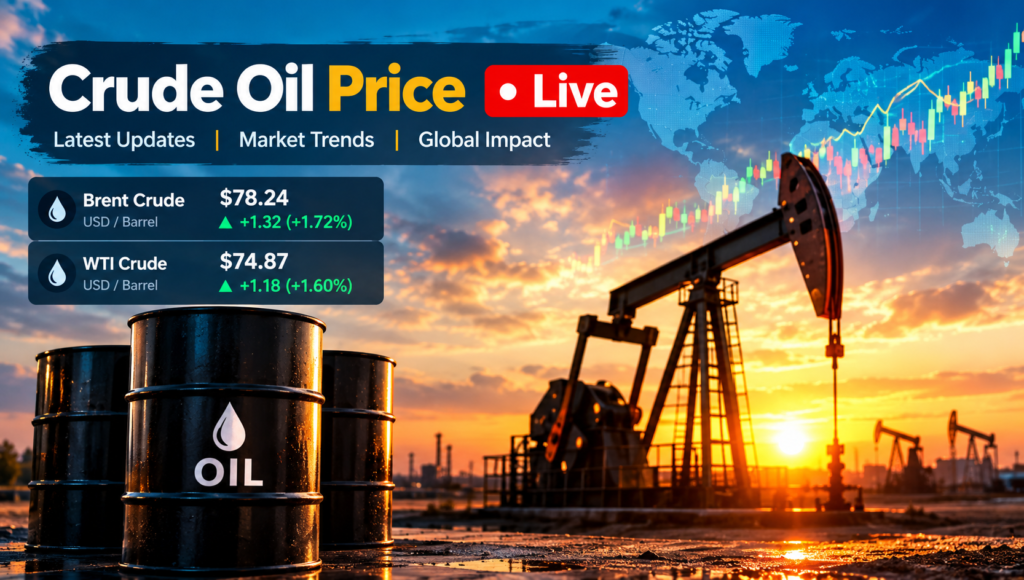
Crude oil price live updates help people understand what is happening in the global energy market. Oil prices change throughout the trading day as buyers, sellers, governments, and energy companies respond to new information.
From fuel costs to transportation and manufacturing, crude oil has a direct or indirect effect on many parts of everyday life. That is why consumers, business owners, analysts, and investors follow oil prices closely.
Understanding live crude oil prices does not require advanced financial knowledge. By learning a few important terms and following reliable sources, anyone can develop a clearer picture of the oil market.
This guide explains how crude oil prices work, where to find market updates, which factors influence price movements, and how to interpret changes without getting confused by market headlines.
What Is Crude Oil Price Live?
Crude oil price live refers to the latest available market price of crude oil. It usually represents the price at which a particular oil benchmark or futures contract is being traded.
Crude oil is a naturally occurring liquid fossil fuel extracted from underground reservoirs. After extraction, it is processed in refineries to produce gasoline, diesel, jet fuel, heating oil, and other petroleum products.
The live price provides a snapshot of market conditions at a particular moment. However, the displayed price may be delayed depending on the website, exchange, or data provider.
Prices are commonly quoted in US dollars per barrel. One barrel contains approximately 159 liters of crude oil.
Why Do People Check Live Oil Prices?
People monitor oil prices for different reasons. Drivers want to understand possible changes in fuel costs, while businesses use oil market information to manage transportation and production expenses.
Energy companies track prices to support purchasing, production, and investment decisions. Traders and analysts study market movements to understand changing supply and demand conditions.
Even people who never trade oil can benefit from knowing why prices rise or fall. Energy costs can influence the prices of goods and services across the economy.
https://www.opec.org/?utm_source=chatgpt.com
Where Can You Check Crude Oil Price Live Updates?
Reliable market information is essential when following crude oil prices. Different websites may display different contracts, timestamps, currencies, or data delays, so always check what the quoted price represents.
The following sources provide useful information about the oil market.
- U.S. Energy Information Administration (EIA): Offers petroleum statistics, inventory reports, historical prices, and energy market analysis.
- CME Group: Provides information about crude oil futures, including West Texas Intermediate contracts.
- Intercontinental Exchange (ICE): Provides information about Brent crude futures and other energy markets.
- Reuters Energy: Publishes energy-market reporting, oil price news, and developments affecting global supply.
For official energy statistics, visit the U.S. Energy Information Administration. For futures market information, explore CME Group’s WTI crude oil resources.
Remember that a price displayed on one website may not match another. The difference can come from the contract month, the benchmark, the time of the quote, or whether the data is delayed.
Understanding Brent and WTI Crude Oil Prices
Two of the most widely followed oil benchmarks are Brent crude and West Texas Intermediate, commonly known as WTI. Both help market participants understand oil pricing, but they represent different markets and delivery arrangements.
What Is Brent Crude?
Brent crude is a major international benchmark used to price a significant share of crude oil traded around the world. It is particularly important for many supplies produced in and around the North Sea.
Brent prices often appear in international energy news because they help indicate broader global oil market conditions. Changes in shipping risks, international demand, and production decisions can influence its price.
What Is WTI Crude?
WTI is a light, relatively low-sulfur crude oil benchmark associated with the United States. WTI futures are traded on the New York Mercantile Exchange, part of CME Group.
The benchmark is important for understanding US oil market conditions. Domestic production, storage levels, pipeline capacity, and refinery demand can influence WTI prices.
Brent vs. WTI: Key Differences
| Feature | Brent Crude | WTI Crude |
|---|---|---|
| Main role | International benchmark | Major US benchmark |
| Market influence | Global supply and demand | US supply and demand, plus global influences |
| Trading reference | ICE futures | CME/NYMEX futures |
| Common quotation | US dollars per barrel | US dollars per barrel |
| Price relationship | Often trades at a premium or discount to WTI | Often trades at a premium or discount to Brent |
The difference between Brent and WTI is known as the Brent-WTI spread. This spread can change with regional supply, transportation costs, storage conditions, and demand for different crude grades.
Neither benchmark is always more expensive. Their relationship changes as market conditions evolve.
What Factors Affect Crude Oil Price Live?
Oil prices respond to several connected factors. A single headline may move the market, but lasting price changes usually depend on how that development affects expected supply, demand, or the availability of oil.
Supply and Demand
Supply and demand are among the most important influences on crude oil prices. When buyers need more oil than producers can readily supply, prices may rise.
When production increases faster than consumption, prices may come under downward pressure. The size of available inventories also matters because stored oil can help balance temporary shortages or excess supply.
These relationships are not always immediate. Traders often react to expectations about future conditions before changes appear in official production or consumption figures.
OPEC and OPEC+ Production Decisions
OPEC and its partners, commonly referred to as OPEC+, influence oil market expectations through production policies and cooperation among participating countries.
If producers announce production cuts, traders may anticipate tighter supply and higher prices. If production rises or expected cuts are reduced, the market may respond differently.
However, production announcements do not guarantee a particular price movement. Actual output, compliance, global demand, and market expectations all influence the outcome.
Geopolitical Events
Conflicts, sanctions, diplomatic disputes, and instability in major producing regions can affect crude oil prices. Markets pay particular attention to events that threaten production facilities or important shipping routes.
Even when physical supplies remain available, uncertainty can increase price volatility. Traders may adjust their expectations because future deliveries could become more expensive or less reliable.
Not every geopolitical event causes oil prices to rise. The market response depends on the scale of the disruption, its expected duration, and whether the risk was already reflected in prices.
US Dollar Movements
Crude oil is commonly priced in US dollars. Changes in the dollar’s value can influence how expensive oil becomes for buyers using other currencies.
A stronger dollar can make dollar-priced commodities more expensive for some international buyers. A weaker dollar may have the opposite effect, although oil prices are also shaped by supply, demand, interest rates, and economic expectations.
The relationship is not automatic. Currency movements should be considered alongside other market indicators rather than used alone to predict prices.
Global Economic Growth
Economic activity affects how much energy the world consumes. When manufacturing, transportation, aviation, and trade expand, oil demand may increase.
A slowdown can reduce fuel consumption and weaken expectations for future oil demand. This is one reason economic forecasts and industrial data can influence crude oil prices.
Markets often react to expected economic changes before they appear in official consumption statistics.
Weather and Natural Disasters
Severe weather can interrupt offshore production, damage energy infrastructure, disrupt shipping, or temporarily close refineries. These disruptions can affect available supplies and regional prices.
Weather also changes seasonal demand. Cold conditions may increase heating fuel consumption in some regions, while summer travel can support demand for transportation fuels.
The effect depends on the location, season, and type of disruption. Weather events do not always have a lasting impact on global crude prices.
Oil Inventories and Storage
Inventory reports help market participants assess whether supplies are increasing or decreasing. In the United States, weekly petroleum reports receive particular attention.
A larger-than-expected inventory build can indicate that supply exceeds immediate demand, potentially pressuring prices. A larger-than-expected draw may suggest stronger consumption or tighter availability.
The comparison with market expectations is important. Prices can move in either direction depending on what traders anticipated before the report was released.
How to Read a Crude Oil Price Chart
A crude oil chart displays price movements over a selected period. It may show intraday changes, daily closing prices, weekly trends, or longer historical patterns.
Learning to read the chart helps you distinguish short-term market noise from broader movements.
https://magazineworker.com/norway-vs-france/
Understand the Price Axis
The vertical axis usually shows the quoted price, commonly in US dollars per barrel. The horizontal axis represents time, such as minutes, days, or months.
Always confirm the selected contract and the chart’s time zone. A chart showing a futures contract may behave differently from one displaying a historical benchmark series.
Understand Candlestick Charts
Candlestick charts show opening, closing, high, and low prices for a selected period. A candle’s body represents the opening and closing levels, while its thin lines show the high and low.
The colors depend on the chart’s settings. A rising candle commonly indicates that the closing price was above the opening price, while a falling candle indicates the opposite.
Candlesticks summarize trading activity, but they cannot explain the reasons behind a price movement by themselves.
Look at Volume and Volatility
Trading volume measures how many contracts were traded during a period. Higher volume can indicate increased participation, although its meaning depends on the market and contract.
Volatility describes how much and how quickly prices change. High volatility can make oil markets more difficult to interpret because prices may respond sharply to new information.
Use charts alongside reliable news, inventory reports, and supply-demand data for a more complete understanding.
How Crude Oil Price Changes Affect Everyday Life
Crude oil prices matter beyond energy exchanges. Their effects can reach households, businesses, transportation networks, agriculture, and manufacturing.
Fuel and Transportation Costs
Crude oil is a major input in producing gasoline, diesel, and other petroleum fuels. When crude prices rise, fuel production costs may increase, potentially putting upward pressure on pump prices.
However, retail fuel prices do not follow crude prices perfectly. Refining costs, distribution expenses, taxes, exchange rates, and local competition also affect the final price.
Likewise, lower crude prices may eventually reduce some fuel costs, but the timing and size of the change vary by location.
Food and Agriculture
Oil and petroleum products support farm machinery, irrigation equipment, food processing, packaging, and transportation. Higher energy costs can therefore increase expenses throughout the food supply chain.
The impact on grocery prices depends on many other factors, including weather, crop yields, labor, storage, and trade conditions.
Crude oil is not the only influence on food prices, but it can be an important part of the overall cost structure.
Manufacturing and Consumer Products
Petroleum is used as a feedstock for many petrochemical products, including certain plastics, synthetic fibers, and industrial materials. Energy costs also influence the operation of factories.
A sustained increase in oil prices may raise production and shipping expenses. Businesses may absorb some costs, improve efficiency, or pass part of the increase to customers.
The effect varies widely across industries because not every company uses the same amount or type of energy.
https://www.reuters.com/business/energy/?utm_source=chatgpt.com
Airlines and Shipping Companies
Airlines rely heavily on jet fuel, while shipping and logistics companies use substantial quantities of marine fuel and diesel. Oil price changes can therefore influence operating expenses.
Companies may respond through fuel-efficiency measures, route adjustments, long-term purchasing agreements, or hedging strategies. These approaches can reduce some exposure, but they do not eliminate every cost risk.
Crude Oil Prices and the Global Economy
Oil prices can affect inflation, trade balances, business confidence, and economic growth. Countries that import large quantities of energy may face higher import bills when prices rise.
Oil-exporting countries may receive greater revenue when prices increase, although the benefit depends on production volumes, government spending, exchange rates, and other economic conditions.
When prices fall, importing countries may benefit from lower energy costs. Exporters may face reduced revenue and pressure on public budgets.
The overall impact depends on the country’s economic structure and how households, companies, and governments respond.
Recent Crude Oil Price Updates: What Should You Watch?
When checking crude oil price live updates, focus on verified market data rather than relying on a single headline. Prices can change rapidly during trading hours, especially after unexpected economic or geopolitical news.
Useful indicators include the latest Brent and WTI quotes, weekly US inventory figures, OPEC+ announcements, production forecasts, and changes in global economic expectations.
Also check whether the reported price represents a spot assessment or a futures contract. A futures price reflects a specific contract and delivery period, so it should not be treated as identical to every physical oil transaction.
For the most recent market level, consult a live data provider and note the timestamp. This article is an educational guide, not a real-time quote feed, and it does not claim that any particular price is current.
Common Mistakes When Following Crude Oil Prices
New readers can misunderstand the oil market when they focus on one number without checking its context.
One common mistake is confusing Brent with WTI. Another is comparing quotes from different contract months or time periods as if they represent the same instrument.
It is also easy to assume that every increase in crude prices immediately raises fuel prices by the same percentage. In practice, refining margins, taxes, currency movements, and distribution costs affect the final price.
Finally, a price rise or fall does not automatically reveal what will happen next. Market conditions change, and even well-informed forecasts can be wrong.
Practical Tips for Tracking Crude Oil Price Live
A consistent approach can make market information easier to understand. Begin by choosing a reliable source and deciding whether Brent or WTI is most relevant to your interests.
Check the timestamp, currency, unit, and contract details whenever you view a quote. Compare price movements with credible reports about inventories, production, and economic conditions.
Avoid making decisions based on an isolated social media post or an unexplained chart. If you are studying the market for educational purposes, keep notes about price changes and the news surrounding them.
If you are considering financial investments, understand that oil-related products carry risks. Futures, leveraged products, and energy shares do not behave exactly like the physical commodity, and losses can occur.
Frequently Asked Questions About Crude Oil Price Live
What does crude oil price live mean
It means the latest available market quote for a crude oil benchmark or contract. The data may be real-time or delayed, depending on the provider.
Where can I check crude oil prices today?
You can consult reputable financial market platforms, CME Group, ICE, and energy information sources such as the EIA. Check timestamps and data terms before relying on a quote.
What is the difference between Brent and WTI?
brent is a major international oil benchmark, while WTI is a key US benchmark. Their prices differ because of market conditions, crude characteristics, location, and transportation factors.
Why do crude oil prices change every day?
Prices respond to supply and demand expectations, production decisions, inventory data, economic conditions, currency movements, and geopolitical developments.
Are crude oil prices quoted per barrel?
Yes. Many benchmark prices are quoted in US dollars per barrel. One standard oil barrel contains approximately 159 liters