
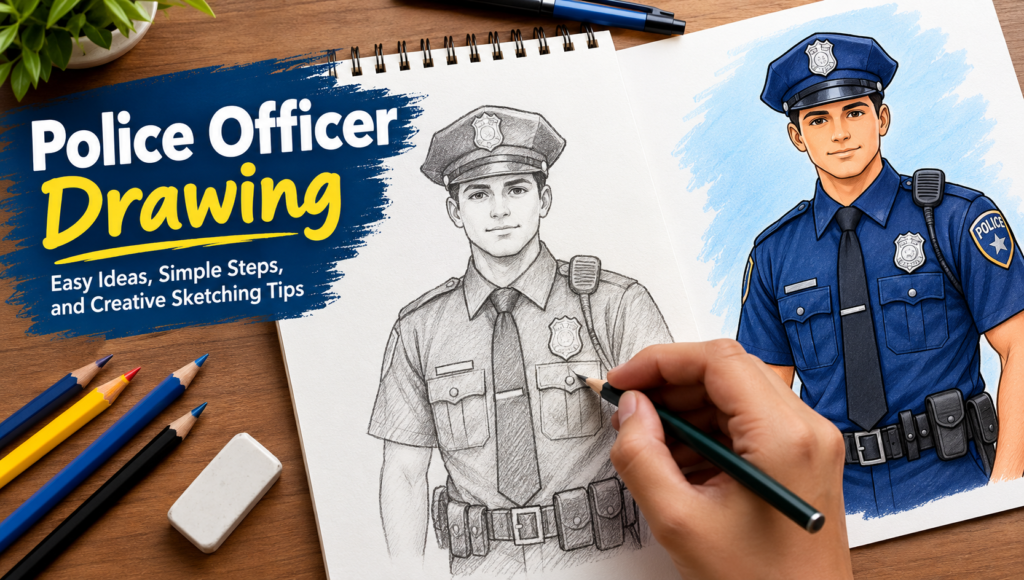
police officer drawing is a fun and creative way to learn about sketching people, uniforms, badges, and different facial expressions. Whether you are a beginner, a student, a parent, or an art lover, drawing a police officer can be an enjoyable activity that improves your artistic skills.
You do not need expensive supplies or professional drawing experience to get started. A pencil, an eraser, a sheet of paper, and a few colors are enough to create an impressive illustration.
This guide explains how to draw a police officer, choose the right drawing style, add uniform details, and make your artwork look more realistic. You will also discover cartoon drawing ideas, coloring techniques, common mistakes, and helpful resources for practicing at home.
What Is a Police Officer Drawing?
A police officer drawing is an illustration of a police officer created using pencils, pens, markers, crayons, or digital drawing tools. It can represent a realistic person, a simple cartoon character, or a detailed professional portrait.
Some drawings focus on the officer’s face and uniform. Others show a full-body figure, a police vehicle, or an officer standing in a recognizable public setting.
The best style depends on your purpose. Children may prefer simple outlines and bright colors, while older students and experienced artists may enjoy realistic shading and detailed uniform designs.
A police officer drawing can also be used for school projects, art assignments, educational posters, coloring pages, and creative activities.
https://www.metmuseum.org/learn
Why Police Officer Drawing Is Popular
Police officer drawings are popular because they combine creativity with recognizable shapes and details. The uniform, badge, cap, belt, and shoes give artists several interesting elements to practice.
Beginners can start with basic geometric shapes and gradually add smaller details. This makes the activity suitable for people who are still learning how to draw human figures.
Drawing can also encourage patience and observation. Every attempt helps you understand proportions, outlines, shapes, and the relationship between different parts of a figure.
For children, a simple police officer illustration can be an engaging way to explore community helpers and learn about the different roles people perform in society.
Materials You Need for a Police Officer Drawing
You can create a good drawing with a small collection of basic art supplies. Start with materials that are easy to use and comfortable to handle.
| Drawing material | How it helps |
|---|---|
| Pencil | Creates the first outlines and shapes |
| Eraser | Removes unwanted marks and corrects mistakes |
| Drawing paper | Provides a clean surface for your artwork |
| Black pen | Adds clear outlines and small details |
| Colored pencils | Adds color and gentle shading |
| Crayons or markers | Creates bold colors for cartoon drawings |
| Ruler | Helps with selected straight lines and accessories |
| Reference picture | Helps you observe uniform details and proportions |
You do not need to purchase everything at once. A pencil and plain paper are enough for your first attempt.
How to Draw a Police Officer Step by Step
Learning to draw a police officer becomes easier when you divide the process into smaller stages. Begin with the overall shape, then work on the uniform, face, and accessories.
Start With Basic Shapes
Begin by lightly sketching a circle or oval for the head. Draw a simple line down the center of the face to help position the features.
Next, create a basic shape for the neck, shoulders, and upper body. Use simple lines to mark the arms and legs if you are drawing a full-body figure.
Do not press the pencil too hard. Light outlines are easier to adjust when the proportions need improvement.
Draw the Police Officer’s Face
Add the eyes, nose, mouth, and ears inside the head shape. Keep the features simple if you are making a cartoon police officer drawing.
For a more realistic portrait, observe the spacing between the eyes and the position of the nose and mouth. Small adjustments can make the face look more balanced.
You can also choose an expression that matches your drawing style. A friendly smile works well for a children’s illustration, while a neutral expression may suit a formal portrait.
Sketch the Police Uniform
Draw the shirt or jacket around the body outline. Include the collar, sleeves, buttons, and pockets.
Uniform designs vary by country, department, and assignment. Use a suitable reference image if you want your illustration to represent a particular uniform accurately.
Keep the clothing lines simple at first. You can add stitching, folds, shoulder patches, and fabric shading after the main outline looks correct.
Add the Police Cap
A police cap is a recognizable part of many uniform designs. Start with a curved shape above the head and add the brim underneath.
Draw a small emblem on the front if it fits your chosen style. Keep the design generic unless you are intentionally illustrating a specific uniform.
Pay attention to how the cap sits on the head. Its position should match the angle of the face rather than appearing to float above it.
https://magazineworker.com/business/
Draw the Badge and Accessories
Add a badge or emblem, belt, pockets, and other details that suit the illustration. These small elements can make the drawing easier to recognize.
Avoid overcrowding the uniform with unnecessary lines. A few carefully placed details often look better than many complicated shapes.
If you are drawing a character for a school project, you can simplify the accessories to keep the picture clean and easy to understand.
Outline and Finish the Drawing
Once the main shapes look balanced, erase the extra construction lines. Trace the final outline with a darker pencil or a black pen.
Add shadows under the cap, around the collar, and along the clothing folds. These details help create a sense of depth.
Finally, check the drawing from a little distance. Correct any uneven proportions or unfinished areas before adding color.
Easy Police Officer Drawing Ideas for Beginners
You can explore different styles without changing the basic subject. Choose an idea that matches your skill level and the time you have available.
Simple Police Officer Drawing
A simple police officer drawing uses basic shapes, clear outlines, and only a few uniform details. It is ideal for beginners who want to practice without feeling overwhelmed.
Focus on the head, shoulders, cap, shirt, and badge. Once you are comfortable with these shapes, try drawing the complete figure.
This style also works well for worksheets, classroom displays, and beginner art exercises.
Cartoon Police Officer Drawing
A cartoon police officer drawing uses simplified features and expressive shapes. You can create a rounded face, large eyes, a friendly smile, and a slightly exaggerated uniform.
Use smooth outlines to make the character look cheerful and approachable. Bright blue, navy, gray, and other suitable colors can help distinguish the clothing from the background.
Cartoon illustrations are particularly useful for children’s drawing activities and creative storytelling.
Realistic Police Officer Drawing
A realistic police officer drawing requires more attention to anatomy, facial proportions, fabric texture, and light. Study a reference image before attempting detailed shading.
Observe where the light falls on the face and uniform. Use lighter pencil marks for highlighted areas and gradual shading for darker sections.
Realism develops through practice. You do not need to reproduce every detail perfectly on your first attempt.
Full-Body Police Officer Drawing
A full-body illustration includes the head, torso, arms, hands, legs, and footwear. The main challenge is keeping the proportions consistent.
Start with a light framework that indicates the height and position of each body part. Draw the uniform over this framework after the pose looks balanced.
Leave enough space around the figure so the cap, hands, and shoes do not touch the edges of the paper.
Police Officer Face Drawing
A face-focused drawing is a useful exercise for practicing facial features and expressions. You can experiment with different head angles and hairstyles while keeping the uniform details simple.
Start with the overall head shape and use light guidelines to position the eyes, nose, and mouth. Add the cap and collar after the facial structure is established.
This approach is especially helpful if you want to create a portrait rather than a full-body illustration.
How to Color a Police Officer Drawing
Color can make your artwork more expressive and easier to understand. However, there is no single color scheme that represents every police uniform.
Choose Suitable Colors
Navy blue, dark blue, black, gray, and white are common choices for generic police illustrations. The appropriate colors depend on the uniform you are representing.
Use a reference picture when accuracy matters. For a cartoon character, you can choose a simplified palette that looks attractive and remains easy to color.
Add Color Gradually
Start with light layers of colored pencil or crayon. Build up the color gradually rather than pressing too hard at the beginning.
Keep the face and hands separate from the uniform colors. Leave small areas lighter where the light would naturally fall.
If you are using markers, test the colors on a spare piece of paper first.
Create Simple Shadows
Shadows help the drawing look less flat. Add gentle darker areas beneath the cap brim, around the collar, and along the folds of the shirt or trousers.
Keep the shading consistent with your imagined light source. When light comes from one side, the opposite side of the figure will generally appear darker.
Tips for Making Your Drawing Look Better
Small improvements can make a noticeable difference to your finished artwork.
- Use light guidelines: Begin with soft pencil strokes so you can correct the shape easily.
- Observe proportions: Check the size of the head, shoulders, torso, arms, and legs.
- Keep the outline clean: Remove unnecessary construction lines before finalizing the picture.
- Study references: Look closely at the uniform, cap, collar, and other details.
- Practice facial features: Spend time improving the eyes, nose, mouth, and overall expression.
- Avoid excessive details: Add only the features that help the drawing look clear and balanced.
- Take your time: Work on one section at a time instead of trying to finish everything immediately.
Remember that drawing is a skill that develops with practice. Mistakes are part of the learning process, and every new attempt gives you a chance to improve.
Common Mistakes to Avoid
Beginners sometimes add too many details before the main figure is correctly proportioned. This can make the final picture look crowded or uneven.
Another common mistake is drawing the head, hands, or feet much larger or smaller than intended. Light construction shapes can help you spot these issues early.
Coloring too heavily can also make corrections difficult. Build color in layers and test your supplies before applying them to the finished drawing.
Finally, avoid copying every line in a reference without understanding its purpose. Observing the larger shapes first will help you develop stronger drawing skills over time.
Police Officer Drawing for Kids and School Projects
A police officer drawing can be a useful activity for children because it combines art with learning about community helpers.
For younger students, use a large sheet of paper and simple outlines. Encourage them to draw a cap, face, uniform, and shoes before adding smaller details.
Older students can experiment with full-body figures, backgrounds, and different coloring techniques. They may also create a poster showing a police officer helping people in the community.
Teachers and parents can adapt the activity to different ages and skill levels. The main goal is to encourage creativity rather than demand a perfect result.
Digital Police Officer Drawing
Digital drawing offers another way to explore police officer illustrations. A tablet, stylus, or computer drawing program can help you create clean outlines and experiment with colors.
Begin with a rough sketch on one layer. Use another layer for the final outline, then add color and shading separately.
Digital tools make it easier to undo mistakes, adjust proportions, and try different color combinations. Some applications also provide brushes that imitate pencils, markers, or paint.
You can use these techniques for digital posters, educational graphics, character designs, and other creative projects.
Ideas for a More Creative Police Officer Illustration
Once you have mastered the basic figure, try adding a simple background or changing the character’s pose.
You could draw a police officer standing beside a vehicle, speaking with a community member, or helping someone find their way. These scenes add context and can make the illustration more interesting.
Another option is to create a small series of drawings showing different uniforms, expressions, or drawing styles. Keep each illustration simple enough to finish comfortably.
You can also combine pencil outlines with watercolor, colored pencils, or digital effects. Experimenting with different materials helps you discover which techniques suit your personal style.
Police Officer Drawing: Quick Comparison of Styles
The following table can help you decide which type of illustration to try.
| Drawing style | Difficulty | Best use |
|---|---|---|
| Simple outline | Beginner-friendly | First drawing attempts |
| Cartoon character | Beginner-friendly | Children’s activities |
| Face portrait | Beginner to intermediate | Facial feature practice |
| Full-body figure | Intermediate | School projects and posters |
| Realistic sketch | Intermediate to advanced | Detailed artwork |
| Digital illustration | Depends on experience | Posters and creative designs |
Choose the style that feels comfortable, then gradually explore more challenging techniques as your confidence grows.
Helpful External Resources for Drawing Practice
Reference materials can help you understand shapes, proportions, and sketching methods. Use trustworthy educational resources to learn general drawing techniques and develop your own style.
Frequently Asked Questions
How can kids make a police officer drawing?
Children can draw simple shapes with a pencil, trace the final outline, and color the uniform using crayons or colored pencils. An easy cartoon style is a good starting point.
Which colors should I use for a police officer drawing?
Navy blue, dark blue, black, gray, and white are useful choices for a generic illustration. Check a reference picture if you want to represent a particular uniform accurately.
Can I draw a police officer without experience?
Yes. Begin with simple outlines and practice one section at a time. You can gradually add shading, clothing folds, and smaller details as your skills improve.
How do I make a police officer drawing realistic?
Study a suitable reference, check the proportions carefully, and use gradual shading to show facial structure and fabric folds. Pay attention to light and shadow.
What materials are best for beginners?
A pencil, eraser, plain paper, and colored pencils are enough for a basic drawing. You can add pens or markers when you become more comfortable with outlinin
https://magazineworker.com/home/
https://www.nga.gov/learn.html
Conclusion
A police officer drawing is an enjoyable way to develop artistic skills, explore character design, and practice drawing uniforms and facial features. Start with basic shapes, add the important details gradually, and experiment with coloring and shading when you feel ready. With patience and regular practice, you can create a simple sketch, a colorful cartoon, or a more detailed illustration that reflects your growing confidence as an artist.