
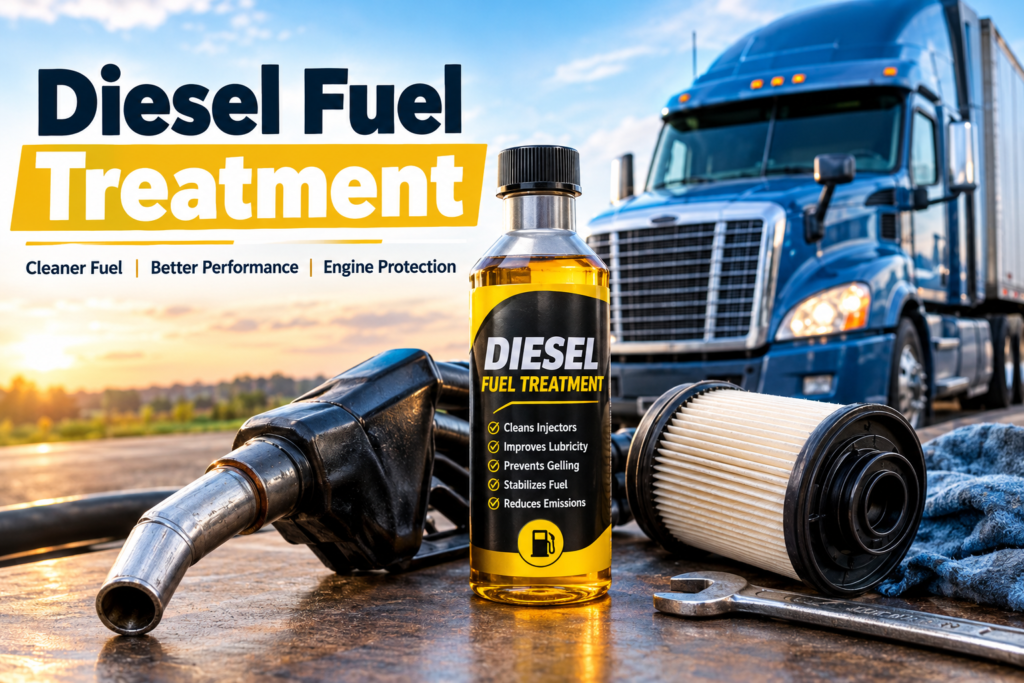
Diesel engines are known for their durability, strong pulling power, and ability to handle demanding workloads. They are used in trucks, cars, buses, tractors, generators, construction equipment, and many other machines. However, even a reliable diesel engine needs clean fuel and regular maintenance to perform properly. This is where diesel fuel treatment can make a difference.
Diesel fuel treatment refers to specially formulated additives designed to address particular fuel-related problems. Depending on the product, a treatment may help clean fuel injectors, improve lubricity, manage moisture, stabilize stored fuel, or reduce the risk of fuel gelling in cold weather.
Not every diesel additive performs the same job. Some products focus on cleaning deposits, while others are designed for winter protection or long-term fuel storage. Choosing the right formula matters more than simply adding an extra product to the tank.
A good maintenance routine also includes purchasing quality fuel, replacing filters when required, inspecting the fuel system, and following the engine manufacturer’s recommendations. Diesel fuel treatment can complement these practices, but it cannot repair every mechanical problem or compensate for poor maintenance.
In this guide, you will learn how diesel fuel treatment works, which benefits are supported by sound maintenance principles, how to choose an appropriate product, and what mistakes to avoid. The goal is to make the subject easy to understand for everyday drivers, truck operators, farmers, fleet managers, and diesel equipment owners.
What Is Diesel Fuel Treatment?
Diesel fuel treatment is a liquid or concentrated additive that is mixed with diesel fuel to address a particular performance or maintenance need. Depending on its formulation, it may help reduce injector deposits, improve fuel lubricity, support cold-weather fuel flow, or maintain fuel stability during storage.
The term covers several different products, so it is important to read the label before purchasing one. A diesel injector cleaner is not necessarily an effective winter additive, and a product intended for stored fuel may not solve an injector problem.
Modern diesel engines often use high-pressure fuel injection systems with tightly engineered components. Contaminants, water, and unsuitable fuel chemistry can interfere with reliable operation. Cummins explains the risks associated with diesel fuel contaminants in its technical guidance. Cummins Inc.
The main purpose of diesel fuel treatment is to support fuel quality when a suitable product addresses a specific need. It is not a replacement for proper diesel fuel, routine servicing, or repairs recommended by a qualified technician.
Tech Tip: How to spot and clean a dirty fuel injector | Vehicle Service Pros
How Diesel Fuel Treatment Works
The way diesel fuel treatment works depends on the ingredients and the intended application. Some formulas contain detergents that help control deposits, while others contain lubricity improvers, cetane improvers, corrosion inhibitors, or cold-flow modifiers.
A detergent-based additive can help manage certain deposits associated with fuel injectors. A lubricity improver is designed to support the protective properties of fuel as it moves through the pump and injection system. Cold-flow additives are formulated to help suitable diesel fuel remain usable under particular low-temperature conditions.
However, these functions are not interchangeable. An additive cannot be expected to remove every contaminant, reverse mechanical wear, or correct fuel that has deteriorated significantly. Some manufacturers also caution that aftermarket additives may be unnecessary or unsuitable for particular engines. Titania Delivery+1
The best approach is to identify the actual maintenance requirement before selecting a treatment. This helps avoid unnecessary expense and reduces the risk of introducing an incompatible product into the fuel system.
Why Diesel Fuel Quality Matters
Diesel fuel quality influences how reliably an engine starts, runs, and delivers power. Clean fuel helps protect the injection system, while suitable ignition quality and lubricity support the engine’s intended operation.
Fuel can become contaminated during transport, delivery, or storage. Dust, sediment, water, and microbial growth can affect stored diesel, particularly when tanks are poorly maintained. Older fuel can also deteriorate and produce unwanted deposits.
Fuel quality is especially important in modern common-rail diesel engines because their injectors operate under demanding conditions. Even small particles can contribute to wear or interfere with delicate fuel-system components. Cummins Inc.+1
Diesel fuel treatment may help with selected fuel-quality concerns, but prevention remains essential. Use reputable fuel suppliers, keep storage tanks clean, maintain fuel filters, and follow the equipment manufacturer’s service schedule.
Main Types of Diesel Fuel Treatment
Different diesel additives serve different purposes. Understanding the categories makes it easier to choose a product that fits your vehicle, generator, truck, or agricultural machine.
Carlube Fuel Injector Cleaner: Enhance Engine Performance
Diesel injector cleaner
Designed to help control or remove certain deposits in the fuel injection system. It may be useful when the product is suitable for the engine and the deposits respond to its detergent chemistry.
Cummins Endorses Two Fuel Additives | Heavy Duty Trucking
Diesel fuel conditioner
A multipurpose formulation that may combine cleaning, lubricity support, corrosion protection, or other functions. The exact benefits depend on the label and technical specifications.
Cold Weather Diesel Protection | Expert Advice
Diesel anti-gel treatment
Intended to improve cold-flow properties in compatible fuel. It must be selected for the expected temperatures and used according to the manufacturer’s directions.
DDS Group | Diesel Decontamination Services
Fuel stabilizer and storage treatment
Formulated for certain storage needs, such as supporting fuel stability or controlling microbial growth where specifically approved. It does not make heavily degraded or contaminated fuel automatically safe to use.
Benefits of Diesel Fuel Treatment
The potential benefits depend on the formulation, the condition of the fuel, and the requirements of the engine. A treatment can be useful when it addresses a real problem, but results vary between vehicles and operating conditions.
Helps Control Injector Deposits
Fuel injectors must deliver diesel in a carefully controlled spray pattern. Deposits can interfere with that process, potentially affecting combustion, engine smoothness, and emissions.
A suitable detergent-based diesel fuel treatment can help control certain deposits and, depending on the formulation, remove some existing deposits. It is not a guaranteed fix for damaged or heavily obstructed injectors.
If the engine continues to run poorly after appropriate maintenance, a professional diagnosis may be needed.
Supports Fuel System Lubricity
Diesel fuel provides lubrication for certain components in the fuel system. A suitable lubricity additive may help improve this property when the fuel or engine application requires it.
Not every engine needs an additional lubricity product. Modern diesel fuels may already meet applicable requirements, and manufacturers sometimes discourage extra additives.
Check the vehicle manual before using a lubricity treatment, especially in a newer engine with a high-pressure injection system.
May Improve Cold-Weather Operation
Low temperatures can cause wax crystals to form in diesel fuel. Under the wrong conditions, these crystals may restrict fuel filters and prevent sufficient fuel from reaching the engine.
An approved cold-flow treatment may help reduce the risk of cold-weather flow problems when used correctly and early enough. It cannot necessarily restore fuel that has already gelled, and it may not work with every fuel blend.
Caterpillar recommends suitable winter-grade fuel and only approved anti-gel additives where needed. Caterpillar
Helps Maintain Fuel Stability During Storage
Diesel fuel can deteriorate during prolonged storage, especially when exposed to unfavorable temperatures, water, or contamination. Certain stabilizers are formulated to help manage oxidation and maintain fuel quality.
A stabilizer is not a universal solution for old fuel. If fuel has darkened significantly, developed sediment, or become contaminated, testing and appropriate fuel-system servicing may be necessary.
Follow the engine manufacturer’s storage guidance before adding any treatment.
May Support Consistent Engine Performance
When deposits are contributing to poor fuel delivery, a compatible cleaning treatment may help the engine return to more consistent operation. Results depend on the original condition of the system and the additive’s effectiveness.
It is important not to assume that every symptom comes from fuel quality. Faulty sensors, worn injectors, air leaks, restricted filters, and other mechanical issues can cause similar problems.
Can Help Protect Stored Fuel Systems
Some specialist treatments are designed to help manage corrosion or microbial contamination in stored diesel. Their suitability depends on the storage system, the type of fuel, and the manufacturer’s recommendations.
If water is present, removing its source and maintaining the appropriate water separator are important steps. A treatment alone cannot replace cleaning or repair when contamination is severe.
May Reduce Unnecessary Maintenance Costs
Preventive maintenance can help reduce avoidable downtime. If a suitable treatment supports injector cleanliness or storage stability, it may form part of an effective maintenance plan.
However, diesel fuel treatment is not automatically a money-saving purchase. Adding a product that the engine does not need can increase costs without delivering a meaningful benefit. Compare the product’s documented purpose with the actual requirements of your equipment.
Diesel Fuel Treatment and Fuel Economy
Fuel economy is one of the most common reasons drivers investigate diesel additives. When an engine has injector deposits or another fuel-related issue, restoring proper operation may help it perform more consistently. However, a diesel fuel treatment does not automatically increase mileage.
Fuel consumption depends on many factors, including vehicle weight, engine condition, driving habits, road conditions, tire pressure, load, maintenance, and fuel quality. A truck carrying heavy cargo will generally use more fuel than the same truck traveling without a load.
A product that claims a specific improvement in fuel economy should provide credible test information relevant to your engine and operating conditions. Be cautious of dramatic promises without supporting evidence.
The practical approach is to monitor fuel consumption over several normal operating cycles. Keep the route, workload, and driving conditions as consistent as possible. If fuel economy does not improve, there may be no measurable benefit from continuing to use the additive.
Diesel Fuel Treatment for Modern Engines
Modern diesel engines use sophisticated fuel injection and emissions-control systems. These systems can be sensitive to unsuitable chemicals, contaminated fuel, and additives that do not meet the manufacturer’s requirements.
Common-rail injection systems operate at high pressures and use carefully engineered injector components. A treatment suitable for an older engine may not be appropriate for a newer vehicle equipped with a diesel particulate filter, selective catalytic reduction, or other emissions equipment.
Before selecting diesel fuel treatment, check the owner’s manual for restrictions on aftermarket additives. Pay attention to warnings about alcohol-based products, metallic ingredients, incompatible cleaners, and unapproved fuel blends.
A product should be chosen for its compatibility with the specific engine rather than its general reputation or advertising claims. If the manufacturer’s instructions say that additional additives are unnecessary, follow that advice.
Diesel Fuel Treatment for Trucks and Commercial Fleets
Trucking Fleet Maintenance Strategies For Optimal Performance | Subscription Free 4G GPS Tracking
Commercial trucks often travel long distances and operate under demanding conditions. Their fuel systems may experience extended operating hours, variable fuel quality, changing temperatures, and periods of heavy loading.
For fleet operators, diesel fuel treatment decisions should be based on maintenance records, fuel supplier quality, equipment specifications, and the cost of downtime.
A fleet maintenance plan may include:
- Buying diesel from reliable suppliers with consistent fuel-quality controls.
- Inspecting storage tanks and keeping fuel-handling equipment clean.
- Servicing water separators and fuel filters at the specified intervals.
- Using approved treatments only when there is a clear operational reason.
- Recording fuel consumption, filter replacements, and recurring fuel-system faults.
- Investigating repeated injector or contamination problems rather than relying on additives alone.
For vehicles operating across different climates, seasonal fuel selection is also important. Fleet managers should confirm that the fuel grade and any supplemental products suit the expected temperatures.
A consistent maintenance policy is usually more useful than allowing every driver to select and mix different additives independently.
Diesel Fuel Treatment for Agricultural Equipment
Tractors, harvesters, irrigation pumps, and other agricultural machines may sit unused for long periods between working seasons. Their fuel systems can face storage-related challenges, particularly when tanks are exposed to moisture or poorly maintained.
For agricultural equipment, prevention begins with clean storage containers, secure tank openings, appropriate ventilation, and regular inspection for water or sediment. The correct storage procedure will depend on the machine, the fuel blend, and the expected storage period.
A compatible fuel stabilizer may be appropriate when recommended for the application. If microbial growth is suspected, a specialist should determine the correct treatment and removal procedure.
Simply adding a biocide may not solve an established contamination problem because dead microorganisms and other debris can continue to obstruct filters. Cleaning the tank and replacing affected filters may also be necessary. OEMDTC
Before seasonal use, inspect the fuel system and follow the equipment manufacturer’s preparation instructions. This is especially important for machines that must start reliably during a short harvesting or planting window.
Diesel Fuel Treatment for Generators
Standby Generator Monthly Run Test Checklist 10 Minute | Free Template
Backup generators depend on reliable fuel because they may be needed after a power outage or during an emergency. Diesel that remains in a storage tank for a long time can gradually deteriorate, and water contamination may create additional problems.
Generator owners should follow the manufacturer’s recommendations for fuel selection, storage duration, tank inspection, and periodic operation. Large storage systems may require a documented fuel-management program and professional testing.
A diesel fuel treatment intended for storage may help with a particular stability concern, but it should not be used to disguise deteriorated fuel or replace proper tank maintenance.
It is also useful to keep records of fuel deliveries, inspections, testing, and filter servicing. These records can help identify recurring contamination and make maintenance decisions more predictable.
Diesel Fuel Treatment in Cold Weather
Cold weather can affect diesel fuel flow, filter performance, battery capacity, engine oil viscosity, and starting conditions. Fuel that works well in warm weather may not perform properly when temperatures fall.
Wax formation is a major concern in cold conditions. As the temperature drops, wax crystals can form and restrict the fuel filter. The exact temperature at which problems occur depends on the fuel formulation and its cold-flow characteristics.
A suitable winter-grade diesel fuel is often the first step. Where the engine manufacturer permits it, an appropriate cold-flow treatment may provide additional support.
Follow these principles when preparing for cold weather:
- Confirm that the diesel grade suits the lowest expected temperature.
- Use only additives approved for the engine and fuel.
- Follow the product’s timing and mixing instructions.
- Maintain the fuel filter and water separator.
- Keep the battery and starting system in good condition.
- Never mix gasoline into diesel fuel as a winter remedy.
Caterpillar’s winter checklist recommends suitable seasonal fuel, approved additives when necessary, and routine attention to fuel filters and water separators. Caterpillar
If fuel has already gelled, adding more additive may not restore normal flow. Follow the equipment manufacturer’s recovery procedure or seek professional assistance rather than using an open flame or an unapproved heating method.
Diesel Fuel Treatment and Water Contamination
Water in diesel fuel can contribute to corrosion, fuel-system wear, filter problems, and microbial growth. It may enter through contaminated deliveries, damaged tank seals, poor storage practices, or condensation.
Some additives are marketed for water management, but their mechanisms vary. Certain formulations help water separate so that a separator can remove it, while other products use different approaches. These functions should not be assumed to be equivalent.
The engine manufacturer’s guidance is especially important because an additive that changes how water behaves in fuel may interfere with a water-separation system if it is not suitable.
If water contamination is suspected, inspect the water separator and storage system according to the maintenance instructions. Significant contamination may require fuel sampling, tank cleaning, filter replacement, or professional servicing.
Do not assume that a bottle of diesel fuel treatment will make contaminated fuel safe for continued use. Correcting the source of contamination is just as important as treating its effects.
Diesel Fuel Treatment and Injector Cleanliness
Fuel injectors control how diesel enters the combustion chamber. Their design and operating condition influence fuel delivery, combustion quality, engine smoothness, and emissions.
Deposits may develop under certain fuel and operating conditions. A suitable detergent additive can help manage some types of deposits, but not all injector faults are caused by contamination.
Symptoms that may justify a professional inspection include rough running, difficult starting, unusual exhaust smoke, reduced power, or a change in fuel consumption. These symptoms can also indicate problems unrelated to injectors.
An additive may be reasonable when the product is approved for the engine and the suspected issue matches its intended use. Persistent symptoms should be investigated with proper diagnostic equipment.
Avoid repeatedly increasing the additive concentration in an attempt to force a result. More product does not necessarily mean better cleaning and may create compatibility problems.
Diesel Fuel Treatment and Cetane Improvers
Cetane number describes an important aspect of diesel fuel’s ignition quality. A cetane improver is intended to raise that number under suitable conditions, potentially helping ignition behavior when the original fuel’s cetane quality is inadequate.
Possible benefits may include improved starting or smoother combustion in an engine that responds to the treatment. Results depend on the fuel, the formulation, and the engine’s requirements.
A higher cetane number is not automatically a guarantee of more power or lower fuel consumption. If the fuel already meets the engine’s requirements, raising the number further may offer little practical benefit.
A cetane improver should also not be confused with an injector cleaner. One focuses on ignition quality, while the other is intended to manage deposits.
For reliable results, follow the fuel specifications and recommendations provided by the vehicle or equipment manufacturer.
Diesel Fuel Treatment and Lubricity Improvers
Lubricity describes a fuel’s ability to help reduce friction and wear in components that rely on the fuel for lubrication. This property is important in certain pumps and injectors.
A lubricity additive may be appropriate when required by a particular fuel specification or recommended by the manufacturer. However, the correct choice depends on the engine and the existing fuel formulation.
Using an arbitrary additive can create compatibility issues. Some products may contain ingredients that are unsuitable for modern injection equipment or emissions systems.
Before using a lubricity improver, confirm that it is designed for your engine and that the dosage follows the product’s technical instructions. Do not assume that every low-sulfur diesel fuel needs an additional lubricity product.
Diesel Fuel Treatment for Long-Term Storage
Diesel fuel storage requires attention to cleanliness, temperature, moisture, and the condition of the tank. These factors can be particularly important for backup generators, seasonal agricultural machinery, boats, and equipment that is not used daily.
Fuel deterioration may lead to gum, sediment, or other unwanted material. Water can also support microbial growth at the boundary between water and fuel.
A storage treatment may be helpful when it is specifically formulated for the fuel and storage conditions. However, a stabilizer cannot reliably reverse every form of fuel degradation.
Good storage practices include keeping tanks sealed and clean, monitoring water accumulation, using appropriate filtration, and inspecting fuel before returning equipment to service.
If fuel has been stored beyond the manufacturer’s recommended period, consider professional assessment rather than assuming that treatment alone will restore it.
How to Choose the Best Diesel Fuel Treatment
Choosing the right diesel fuel treatment starts with identifying your objective. A product marketed as the best overall option may not be the most appropriate choice for your vehicle or working conditions.
Consider these factors before purchasing a treatment.
Check Engine Compatibility
Start with the owner’s manual or equipment service documentation. Confirm whether aftermarket additives are permitted and whether the manufacturer specifies particular ingredients or standards.
This is especially important for newer diesel engines, which may have advanced injection systems and emissions-control equipment.
Identify the Problem You Want to Address
Choose a product based on the actual maintenance need. An injector cleaner is intended for deposits, a cold-flow additive addresses certain low-temperature concerns, and a stabilizer is designed for specific storage needs.
If the engine has a mechanical fault, the right solution may be diagnosis and repair rather than an additive.
Read the Product Label
Check the intended application, compatible fuel types, dosage instructions, storage recommendations, and warnings. Look for technical information that explains the product’s purpose instead of relying solely on broad marketing claims.
Review Independent Technical Evidence
Credible testing is more useful than unsupported promises. Look for documented performance results relevant to your fuel type and engine category.
Consider the Total Cost
A larger bottle is not necessarily better value. Compare the amount required per tank or storage volume, the product’s intended use, and whether your equipment actually needs the treatment.
Diesel Fuel Treatment Comparison Table
The following table summarizes common additive categories and the situations in which they may be appropriate.
| Treatment type | Main purpose | When it may be useful | Important limitation |
|---|---|---|---|
| Injector cleaner | Controls certain deposits | When injector deposits are suspected | Cannot repair damaged injectors |
| Fuel conditioner | Combines selected maintenance functions | When its listed functions match an identified need | Formulations vary considerably |
| Anti-gel additive | Supports cold-weather fuel flow | Before expected cold conditions, when approved | May not resolve fuel that has already gelled |
| Cetane improver | Improves ignition quality | When fuel quality and engine requirements justify it | Higher cetane does not guarantee more power |
| Lubricity additive | Supports fuel lubricating properties | When recommended for the fuel and engine | Extra treatment may be unnecessary |
| Fuel stabilizer | Supports fuel stability during storage | For compatible fuel kept in storage | Cannot restore all degraded fuel |
| Specialist biocide | Controls certain fuel-system microorganisms | When contamination is confirmed and treatment is appropriate | Dead microbial material may still block filters |
The correct choice depends on the engine manufacturer’s recommendations, fuel condition, and the product’s documented compatibility.
How to Use Diesel Fuel Treatment Correctly
Using diesel fuel treatment correctly is important for both effectiveness and equipment protection. Even a suitable product can cause problems if it is used in the wrong application or at an inappropriate concentration.
Read the Instructions First
Check the product label and the vehicle manual before opening the container. Confirm the recommended application, compatible fuel type, dosage, and any restrictions.
Never assume that instructions for one brand or formulation apply to another.
Measure the Correct Amount
Use only the specified quantity for the relevant fuel volume. Overdosing is not a reliable way to improve results and may create unwanted fuel-system or emissions-system issues.
Follow the Mixing Procedure
Some products are intended to be added before refueling, while others have different application instructions. Follow the label rather than assuming that every additive must be used in the same order.
Monitor the Engine
After using an approved treatment, observe whether the specific issue improves. Keep track of fuel consumption, starting behavior, and any recurring symptoms under normal operating conditions.
If warning lights appear or the engine develops a persistent problem, arrange a professional inspection.
Keep Records for Work Equipment
For trucks, tractors, and generators, record the product used, the reason for using it, and the date of application. This makes it easier to identify patterns and avoid unnecessary repeated treatments.
Common Mistakes to Avoid
Diesel fuel treatment can be useful in the right circumstances, but several mistakes can reduce its value or create unnecessary risk.
Using additives without checking compatibility: Not every formulation is appropriate for every diesel engine. Follow the manufacturer’s requirements.
Mixing multiple products unnecessarily: Combining additives can produce unpredictable results if their ingredients or functions are incompatible.
Overdosing the fuel: More additive does not automatically produce better cleaning or performance.
Ignoring contaminated fuel: Water, sediment, and microbial contamination may require removal, filtration, testing, or professional cleaning.
Expecting instant repairs: An additive cannot reliably correct worn injectors, failed pumps, damaged sensors, or other mechanical defects.
Using a summer fuel in unsuitable winter conditions: Select seasonal fuel appropriate to the expected temperature and follow the manufacturer’s cold-weather recommendations.
Ignoring maintenance intervals: Fuel treatment does not replace filter changes, water-separator servicing, or scheduled engine maintenance.
Believing every advertised fuel-economy claim: Actual results depend on fuel condition, engine design, workload, driving style, and the product itself.
Signs Your Diesel Fuel System May Need Attention
A change in engine behavior can sometimes indicate a fuel-related problem. However, symptoms alone do not establish that an additive is necessary.
Watch for:
- Difficult starting that was not present previously.
- Unusual engine roughness or inconsistent operation.
- Reduced pulling power under normal working conditions.
- Unexpected changes in fuel consumption.
- Frequent fuel-filter restrictions.
- Unusual exhaust smoke or persistent warning lights.
These signs can have several causes. For example, a clogged filter may restrict fuel delivery, but a sensor fault or injector problem may produce similar symptoms.
If the problem continues, have the fuel system checked by a qualified mechanic. Correct diagnosis can prevent wasted money on products that do not address the underlying fault.
Diesel Fuel Treatment vs. Regular Diesel Fuel
Regular diesel fuel that meets the appropriate specifications is designed to operate within the requirements of compatible engines. Fuel suppliers may already include additives as part of the fuel formulation.
Aftermarket diesel fuel treatment is an additional product intended to address a particular concern or provide a specific function. It is not automatically required whenever a vehicle is refueled.
The distinction matters because high-quality fuel may already have the necessary properties for normal operation. Adding a second product could provide little benefit or, in an unsuitable application, interfere with the fuel’s existing formulation.
The U.S. Department of Energy’s guidance on biodiesel fuel management discusses the importance of cleanliness, water control, stability, and proper handling. The Department of Energy’s Energy.gov
For everyday drivers, choosing reputable fuel and following the vehicle maintenance schedule should come first. Consider an additional treatment only when it is compatible and serves a clearly identified purpose.
Is Diesel Fuel Treatment Worth the Money?
Diesel fuel treatment can be worth the cost when it addresses a genuine need and is compatible with the engine. For example, a manufacturer-approved winter additive may be useful under certain cold-weather conditions, while a suitable detergent product may help control specific injector deposits.
The value is less clear when a vehicle already receives appropriate fuel and has no identified fuel-related issue. In that situation, buying an additive simply because it promises extra power or impressive mileage may not be worthwhile.
To evaluate value, compare the product’s price with its documented purpose, dosage, and realistic expected benefit. Consider the cost of preventive maintenance, but do not assume an additive will prevent every expensive repair.
For commercial operators, keeping records can help establish whether a treatment provides a measurable improvement. For personal vehicles, the same principle applies: make decisions based on evidence, compatibility, and actual engine needs rather than advertising alone.
Environmental Considerations
Diesel engine emissions depend on fuel quality, combustion, engine condition, and the performance of emissions-control equipment. A suitable additive may help control certain deposits or support proper operation, but it should not be treated as a guaranteed emissions-reduction solution.
Using incompatible products may damage fuel-system components or affect emissions equipment. Proper disposal of unused additives and contaminated fuel is also important.
Follow the product’s safety label, avoid spills, and keep fuel additives away from children and pets. Do not pour leftover products or contaminated fuel into drains, soil, or waterways. Follow local waste-disposal requirements.
Maintaining the engine, repairing faults promptly, and using the correct fuel are essential parts of responsible diesel equipment ownership.
Expert Tips for Better Diesel Engine Maintenance
A sensible maintenance routine is more effective than relying on a single additive to solve every problem.
- Purchase fuel from reputable suppliers.
- Use the fuel grade recommended for your engine.
- Replace filters at the specified intervals.
- Inspect storage tanks and fuel-handling equipment regularly.
- Drain water separators according to the manufacturer’s instructions.
- Prepare for seasonal temperature changes.
- Avoid unapproved fuel mixtures and chemical combinations.
- Keep records of maintenance, repairs, and fuel-related symptoms.
- Investigate recurring problems rather than repeatedly treating the fuel.
- Use diesel fuel treatment only when its purpose and compatibility are clear.
https://magazineworker.com/maximillian-fuse/
The most important principle is simple: protect fuel quality first, then use an appropriate treatment when there is a clear reason to do so.
Frequently Asked Questions About Diesel Fuel Treatmen
What is diesel fuel treatment used for?
Diesel fuel treatment is used for specific fuel-maintenance purposes, such as controlling injector deposits, supporting lubricity, improving cold-weather flow, or helping maintain fuel stability during storage. Its function depends on the formulation.
Is diesel fuel treatment necessary for every diesel engine?
No. Many diesel engines operate correctly with fuel that meets the required specifications. Additional treatment should be used only when it is compatible with the engine and serves a clear purpose.
Can diesel fuel treatment improve fuel economy?
It may help in certain situations if it addresses a fuel-related issue affecting engine operation. However, improved mileage is not guaranteed, and results depend on the engine, fuel, driving conditions, and product.
How often should diesel fuel treatment be used?
There is no universal schedule. Some products are designed for occasional use, while others have different application instructions. Follow the product label and your engine manufacturer’s recommendations.
Can diesel fuel treatment clean injectors?
Some detergent-based treatments can help control or remove certain injector deposits. They cannot reliably repair damaged injectors or resolve every fuel-delivery problem.
https://magazineworker.com/japan-technology-news-today/
https://www.cummins.com/en-apac/engines/diesel-fuel-contaminants?utm_source=chatgpt.com
Conclusion
Diesel fuel treatment can be a useful part of diesel engine maintenance when the selected product addresses a specific need. Whether you want to manage injector deposits, prepare equipment for cold weather, or maintain stored fuel, compatibility and correct application are essential.
The best results start with clean, suitable diesel fuel, reliable suppliers, regular filter servicing, and attention to the manufacturer’s recommendations. A treatment can support these practices, but it cannot replace them or repair every mechanical fault.
Choose diesel fuel treatment based on documented benefits rather than bold marketing promises. With sensible fuel management and consistent maintenance, you can help keep your diesel-powered vehicle or equipment operating reliably.