
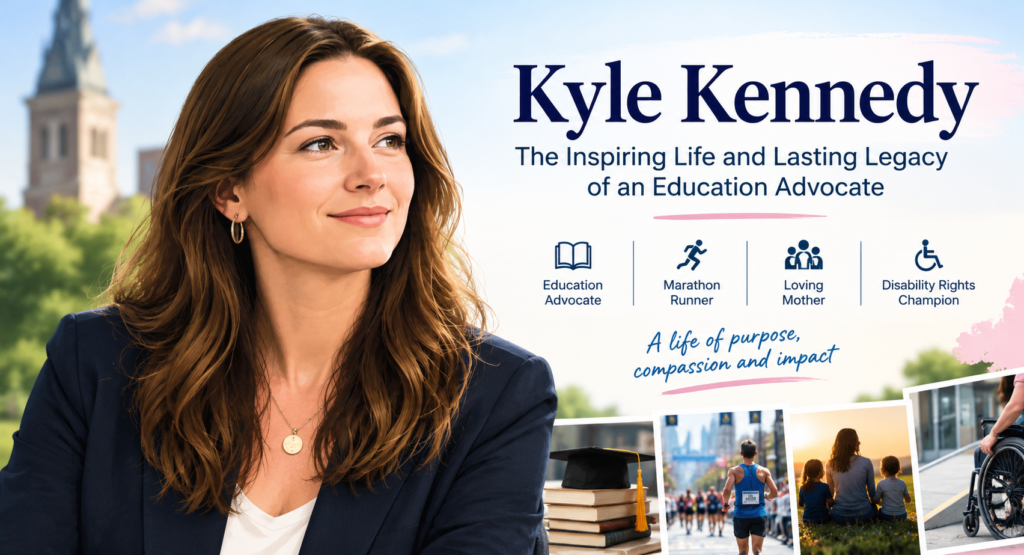
Kyle Kennedy was an American educator, education reform advocate, mother, and disability rights supporter whose life reflected a commitment to helping others. She was also a granddaughter of Robert F. Kennedy and Ethel Kennedy, members of one of America’s most widely recognized political families. However, her story extended far beyond her family name.
Kyle Kennedy dedicated much of her professional life to improving education for children, supporting teachers, and encouraging fair treatment for people with disabilities. Her personal experiences, professional achievements, and determination made her life a subject of renewed public interest following reports of her death in September 2026.
This article explores Kyle Kennedy’s biography, education, career, family background, achievements, advocacy, and the legacy she leaves behind.
Who Was Kyle Kennedy?
Kyle Francis Kennedy was known for her work in education and her commitment to helping people who faced barriers to opportunity. She was born on July 6, 1984, in Washington, D.C., and spent much of her early life in Cohasset, Massachusetts.
Although she grew up in a prominent American family, Kyle developed her own interests and professional goals. Education became an important part of her life, and she pursued opportunities to make schools more effective and accessible for children from different backgrounds.
Her professional journey included classroom teaching, education reform, and work connected to improving school curricula. Later in life, she also became an advocate for people living with disabilities.
Kyle Kennedy died at her home in Westwood, Massachusetts, on September 21, 2026, at the age of 42, according to published reports and her family obituary. Her cause of death had not been publicly establish

Kyle Kennedy Biography at a Glance
The following table summarizes the main publicly reported details about Kyle Kennedy.
| Detail | Information |
|---|---|
| Full name | Kyle Francis Kennedy |
| Date of birth | July 6, 1984 |
| Birthplace | Washington, D.C., United States |
| Parents | Michael Kennedy and Victoria Gifford Kennedy |
| Grandparents | Robert F. Kennedy and Ethel Kennedy |
| Education | Georgetown University, Pace University, Harvard Graduate School of Education |
| Profession | Educator and education reform advocate |
| Other work | Disability rights advocacy |
| Known achievement | Completed the Boston Marathon in 2019 |
| Residence | Westwood, Massachusetts |
| Date of death | September 21, 2026 |
| Age at death | 42 |
These details are drawn from published reporting and her obituary.
The Guardian
+2
Kyle Kennedy’s Early Life and Family Background
Kyle Kennedy was born into the Kennedy family, a family that has played a significant role in American political and public life. Her grandfather, Robert F. Kennedy, served as U.S. attorney general and later became a senator and presidential candidate.
Her grandmother, Ethel Kennedy, was widely recognized for her humanitarian work and involvement in public causes. Growing up connected to this family meant that Kyle’s background was part of a much larger American story.
Nevertheless, her own interests were not limited to politics or public recognition. She developed a strong interest in learning, competition, and education. Those interests eventually influenced the career she chose.
Kyle spent much of her childhood in Cohasset, Massachusetts. Her family environment included academic expectations, public service, and a history of involvement in community affairs.
Her life also included difficult personal experiences. Her father, Michael Kennedy, died in a skiing accident in Colorado on December 31, 1997. Kyle was still a teenager at the time.
Despite the challenges associated with her family’s history, Kyle continued her education and built a professional identity of her own. Her later work demonstrated that she wanted to contribute through practical efforts rather than relying solely on her family connections.
Kyle Kennedy’s Education and Academic Achievements
Education was central to Kyle Kennedy’s life. She attended Milton Academy before continuing her studies at Georgetown University in Washington, D.C.
At Georgetown, she studied history and developed an academic foundation that supported her interest in society, learning, and public issues. Her university experience also included a semester abroad in Florence, Italy, where she developed an appreciation for Tuscan Renaissance art and culture.
Her education did not end with her undergraduate degree. Kyle later earned a Master of Science in Early Education from Pace University and a Master of Education in Education Policy and Management from the Harvard Graduate School of Education.
These qualifications helped prepare her for work that combined classroom teaching with broader questions about how schools operate.
Early education is particularly important because the experiences children have during their first school years can influence their later academic development. Kyle’s academic background equipped her to explore how schools could better serve young learners.
Her studies in education policy also provided a foundation for considering issues such as curriculum quality, teacher support, and equal educational opportunities.
Rather than treating education as a subject confined to textbooks, Kyle pursued a career that connected academic knowledge with practical work in schools and education reform.
https://magazineworker.com/health/
Kyle Kennedy’s Career as an Educator
Kyle Kennedy began her professional career through Teach for America, an organization that places educators in schools serving communities with educational needs.
Through this program, she taught in New York City’s public school system. The experience gave her direct exposure to the responsibilities teachers manage every day, including helping students understand lessons, encouraging classroom participation, and supporting different learning needs.
Teaching can be challenging because students do not all learn at the same pace. Effective educators must adjust their methods, communicate clearly, and create an environment where children feel encouraged to participate.
Kyle’s classroom experience became an important foundation for her later work in education reform.
After teaching, she continued pursuing opportunities to improve the educational experience for children. Her professional work included efforts to support more equitable elementary education and charter schooling.
She also worked with technology companies focused on improving school curricula. These roles connected her teaching experience with the development of educational resources and tools.
Her career reflected an understanding that improving education requires more than asking students to work harder. Schools also need useful learning materials, effective teaching practices, and systems that help educators meet the needs of their students.
Kyle Kennedy’s professional path therefore combined classroom experience with efforts to improve education at a broader level.

Kyle Kennedy and Education Reform
Education reform was one of the most important themes in Kyle Kennedy’s professional life.
Education reform involves examining how schools teach students, how teachers receive support, and whether children have access to effective learning opportunities. The goal is to identify weaknesses and make improvements that can benefit students and communities.
https://magazineworker.com/Home/
Kyle supported efforts to make elementary education more equitable, particularly for children who faced disadvantages.
A student’s educational experience can be influenced by several factors, including access to learning materials, the quality of instruction, family circumstances, and the resources available at school. Addressing these differences requires thoughtful planning and cooperation.
Her work with education technology companies also connected her to curriculum improvement. Well-designed curricula help teachers organize lessons, introduce concepts clearly, and build students’ understanding over time.
Technology can support this work by providing additional learning resources and helping educators adapt materials to classroom needs. However, technology works best when it supports good teaching rather than replacing teachers.
Kyle’s experience as both an educator and an education advocate gave her a practical perspective on these issues.
Her professional contributions are a reminder that meaningful improvements in education often happen through consistent work, collaboration, and attention to children’s needs rather than through publicity alone.
https://www.theguardian.com/us-news/2026/oct/20/kyle-kennedy-dead-rfk?utm_source=chatgpt.com
Kyle Kennedy’s Personal Life and Family
Kyle Kennedy’s personal life was closely connected to her role as a mother and family member.
She married Liam Kerr in Boston in August 2012. The couple had three children: Conor, Josephine, and Declan. Their daughter Josephine, also referred to as Josie, died shortly after birth.
Kyle and Liam later separated, and published accounts described him as her former husband.
Family was an important part of Kyle’s life, and her obituary emphasized her devotion to her children. Her family life continued to matter to her during periods of significant personal difficulty.
She was the daughter of Michael Kennedy and Victoria Gifford Kennedy. Her siblings included Michael Kennedy Jr. and Rory Kennedy.
Although her family name attracted public interest, much of Kyle’s private life remained outside the public spotlight. It is important to distinguish verified biographical information from speculation about the private experiences of her family.
Her story shows that public figures and members of prominent families also have personal responsibilities, relationships, and experiences that deserve to be treated with respect.
Kyle Kennedy’s Love of Sports and Running
Athletics was another important part of Kyle Kennedy’s life.
Reports about her life describe her as naturally competitive and interested in sports from an early age. She participated in activities that required energy, discipline, and teamwork.
As an adult, she developed a passion for long-distance running. One of her most notable athletic achievements was completing the Boston Marathon in 2019.
The Boston Marathon is one of the world’s best-known long-distance running events. Completing it requires preparation, endurance, and the ability to manage the physical demands of a challenging course.
Kyle completed the marathon in difficult rainy weather. According to her obituary, she finished approximately twenty minutes faster than her father’s marathon time.
This achievement became a memorable part of her biography because it reflected a personal interest that she pursued with determination.
Running also requires patience. Training involves gradually building endurance, learning how to manage effort, and maintaining a consistent routine. For many participants, completing a marathon represents a personal milestone as much as a sporting accomplishment.
Kyle’s marathon achievement illustrates the role sports played in her life before her later health challenges changed her circumstances.

Kyle Kennedy’s Spinal Cord Injury and Health Challenges
In 2020, Kyle Kennedy experienced a severe spinal cord injury that resulted in long-term paralysis, according to her family’s obituary.
The injury brought substantial changes to her life and introduced medical and accessibility challenges. Public reporting does not establish every detail surrounding how the injury occurred, so it is important not to repeat unverified explanations.
A spinal cord injury can affect movement, sensation, and everyday activities in different ways, depending on the nature and location of the injury. People living with these conditions may need medical care, rehabilitation, accessibility accommodations, and long-term support.
For Kyle, the years after her injury included significant personal challenges. Her obituary described her determination to remain engaged with family life and continue caring for her children.
Her experience also brought greater attention to disability-related issues.
Disability can affect many parts of everyday life, but the challenges people encounter are not determined by their medical conditions alone. Inaccessible buildings, limited transportation options, inadequate services, and unfair treatment can create additional barriers.
Accessible environments and appropriate support can make a meaningful difference in helping people participate in education, work, family life, and public activities.
Kyle’s experience became an important part of her later advocacy, connecting her personal circumstances with broader questions about equal treatment and accessibility.
Kyle Kennedy’s Disability Rights Advocacy
After her spinal cord injury, Kyle Kennedy became an advocate for people living with disabilities.
Her advocacy included speaking about discrimination in health care for people with disabilities. She testified at a hearing at the Massachusetts State House concerning this issue.
Health care accessibility is an important public concern because patients should be able to obtain appropriate services without facing unfair treatment based on disability.
Barriers may include inaccessible facilities, communication difficulties, inadequate accommodations, or assumptions about a person’s needs. Addressing these issues requires attention to both the quality of medical services and the way patients are treated.
Kyle’s advocacy helped bring attention to these concerns through her involvement in a legislative hearing.
Her participation also demonstrated how personal experience can inform public discussion. People who encounter accessibility barriers may identify problems that are overlooked by institutions that do not regularly consider those experiences.
Disability rights advocacy can involve many forms of work, including public testimony, policy discussions, community education, and efforts to improve services.
Kyle’s contribution was part of a wider effort to encourage fair treatment and better access to health care for people living with disabilities.
Her work remains a meaningful element of her public legacy because it addressed an issue that affects individuals, families, medical professionals, and public institutions

Kyle Kennedy’s Connection to the Kennedy Family Legacy
The Kennedy family has been part of American political history for generations.
Robert F. Kennedy served as attorney general during his brother John F. Kennedy’s presidency. He later became a U.S. senator from New York and ran for president in 1968. His assassination that year had a lasting impact on American public life.
Ethel Kennedy, Kyle’s grandmother, was also known for her involvement in public service and humanitarian causes.
Kyle was connected to this history through her family, but her own career focused primarily on education and disability advocacy.
This distinction is important when discussing her life. A prominent family background may explain why someone attracts public attention, but it does not fully explain their individual accomplishments or interests.
Kyle’s work in schools, her involvement in curriculum improvement, and her advocacy for people with disabilities formed a professional identity of their own.
Her story illustrates how different generations of a family can contribute to society in different ways. Some may work in politics, while others focus on education, community service, research, or advocacy.
For Kyle Kennedy, the most meaningful part of that legacy may be the practical work she pursued in areas that directly affected children, educators, and people living with disabilities.
Kyle Kennedy’s Death and Public Tributes
News of Kyle Kennedy’s death became public in October 2026, following reports that she had died on September 21 at her home in Westwood, Massachusetts.
She was 42 years old. Her family obituary described her as devoted to her children and committed to education reform and support for people living with disabilities.
Her funeral service was held privately, according to published accounts.
At the time of the initial news reports, authorities had not publicly confirmed a cause of death. Any claim about the circumstances of her death should therefore be treated cautiously unless supported by a reliable, updated source.
Public attention surrounding her death also renewed interest in her professional achievements and personal story.
Obituaries often provide an opportunity to understand a person’s life beyond the headline. In Kyle’s case, her educational work, athletic interests, family relationships, and disability advocacy all help explain why her biography attracted attention.
Remembering her life involves recognizing both her accomplishments and the people closest to her. Her story should not be reduced to her family name or the challenges she experienced.
Instead, her life can be understood through the combination of professional dedication, family commitments, and efforts to improve the experiences of others.
What Made Kyle Kennedy’s Life Significant?
Kyle Kennedy’s life is significant for several reasons.
First, she pursued a career focused on education. Her work began in classrooms and later extended to education reform and curriculum development.
Second, she demonstrated a strong interest in athletics. Completing the Boston Marathon was a notable personal achievement that reflected her enthusiasm for running.
Third, her experience with disability led her to engage with issues of accessibility and fair treatment. Her participation in a Massachusetts legislative hearing helped draw attention to discrimination in health care.
Finally, her biography offers a reminder that individual contributions can take many forms. Not everyone who makes a difference works in government or holds a highly visible public position.
Teachers, education advocates, parents, and disability rights supporters can influence communities through their everyday work and public participation.
Kyle’s career brought these roles together. Her professional interests centered on helping children learn, while her later advocacy focused on improving the experiences of people living with disabilities.
These areas of work remain relevant because education and accessibility affect opportunities throughout life.
Lessons From Kyle Kennedy’s Story
Kyle Kennedy’s biography offers several useful lessons about education, public service, and personal commitment.
Education can create opportunities. Teachers and education advocates help students build knowledge and develop skills that can influence their future.
Professional identity is personal. A person’s family background may attract attention, but their own work and values are also important parts of their story.
Accessibility matters. People living with disabilities deserve fair treatment and environments that support meaningful participation in everyday life.
Personal experiences can inform advocacy. People who encounter barriers may help institutions understand where policies and services need improvement.
A meaningful legacy can take many forms. Education, family care, public testimony, and community involvement can all contribute to a person’s impact.
These lessons are relevant beyond Kyle Kennedy’s biography. They encourage readers to think about how education and accessibility can be improved in their own communities.
Frequently Asked Questions About Kyle Kennedy
Who was Kyle Kennedy?
Kyle Francis Kennedy was an American educator, education reform advocate, and disability rights supporter. She was the granddaughter of Robert F. Kennedy and Ethel Kennedy.
How old was Kyle Kennedy when she died?
Kyle Kennedy was 42 years old when she died on September 21, 2026, according to her obituary and published reports.
Who were Kyle Kennedy’s parents?
Her parents were Michael Kennedy, the son of Robert and Ethel Kennedy, and Victoria Gifford Kennedy.
Where did Kyle Kennedy study?
She attended Georgetown University, Pace University, and the Harvard Graduate School of Education.
What did Kyle Kennedy do for a living?
She worked in education, taught in New York City through Teach for America, supported education reform, and worked with technology companies focused on improving school curricula.
Conclusion
Kyle Kennedy’s life brought together education, family, athletic achievement, and disability rights advocacy. Although she came from a prominent American family, her own professional contributions focused on helping children and supporting fair treatment for people living with disabilities. Her story remains a reminder that meaningful legacies are built through dedication, compassion, and efforts to improve other people’s lives.
https://apnews.com/article/f05ee8fef7cc79408f4455c3643c10af?utm_source=chatgpt.com